
I don’t recall feeling cute or pretty during my growing up years, but I was told by elementary teachers that I was smart. I never attended kindergarten, but had learned to read from my older siblings. First and second grade at the Ingram elementary school was boring for me. I was already reading books when I entered first grade as the teacher (Mrs. Swanepoel) taught letters, numbers and words.
Mrs. Swanepoel made me feel welcome and included in class activities. At the Ingram Elementary School, there were three classrooms for grades 1-6. Each room had two grades with a total of 10-14 students in each room. My neighborhood Mennonite friend, Rita, was in my same grade so although attending public school was a social adjustment, I never felt afraid to go to school. In 2nd grade, I was tasked with being a reading tutor for other classmates who were struggling. She would send me into the hallway with another student and I would listen to them read and help them sound out the words they didn’t know. Most of first and second grade was repetition of what I already knew.
Two memorable things happened during my grade school years at Ingram. One time, I was trying to be silly and caused a classmate to break a tooth. Our class was returning from recess, and we all waited in line at the water fountain to have a drink. The classmate in front of me was taking a drink when I tapped their head with the intent to cause them to get water on their face. It was a naughty thing to do. They hit their face on the hard fountain and suffered an injury. I was horrified, scared and felt so ashamed of my action. A year or two later during recess play, I tripped over a ball and chipped my front tooth. I think I was in the 5th or 6th grade. As I recall, the school paid for me to see a dentist, and I was surprised that Pa agreed to take me there. The dentist said the chip was minor and it wouldn’t cause my tooth further decay, so it was okay to leave it as is. I was always embarrassed of my chipped tooth and learned to smile so it wouldn’t show in photos.
I attended grades 1-6 at Ingram Elementary, grades 7-8 at Glen Flora junior high, and high school years 9-12 at Tony. All these schools were within the public Flambeau School District.
In Glen Flora during Junior High, my aunt Rita taught math and science. Rita was married to Ma’s brother, Jim Berge. Rita was a strong, well-educated, out-spoken, no-frills person. Aunt Rita had made it clear to Pa that she disagreed with his religious philosophy about the evils of medical science and his refusal to take any of us kids to the doctor when we were sick. She would say, “that’s just phooey.” In eighth grade, Rita took me aside one day and said, “If you ever need to leave home, you come to my place anytime day or night. You don’t need to call and ask permission or make arrangements. Just show up.” If she wasn’t home, she told me I could just go in the house – the back door was always open. Looking through my junior high memorabilia recently I came across our Eighth Grade class booklet where everyone wrote end of year notes to each other. Aunt Rita wrote in mine, “I think you’re a real doll. Come live with me anytime!”
During my four years attending Flambeau High School, I felt out of sync from classmates who attended sports events and cheered on the Falcons. Although our family sang music, I wasn’t allowed to join the choir because they didn’t sing all Christian music. I never participated in sports or physical education because Pa didn’t allow us to compete in anything. My Mennonite girlfriends, Karen Stoll and Rita Schrock, dressed similar to me and we enjoyed good camaraderie. Although I wasn’t pretty, fashionable or popular, I enjoyed the attention from getting good grades. All of my classmates seemed to respect me because I was “smart.” I wasn’t actually all that smart, but I studied hard and was able to do well on most tests and assignments.
During those high school years, I took a Journalism class under the tutelage of Mrs. Helen Sobieski. She was strict and expected high standards from her students, but she was also encouraging and enthusiastic. I thrived under her guidance. Mrs. Sobieski was a lifeline for me during those high school years.
Mrs. Sobieski taught English and Journalism and managed the school newspaper. All of us in the Journalism classes submitted our assignments to her and hoped to get them published in the school paper, the Flambeau Ferret. Eventually I joined the newspaper as a staff writer, and in my Senior Year served at the Student Editor. It was an environment where I felt a sense of belonging. Both of my sisters, Doris and Jane, were working full-time jobs in Ladysmith a few miles away from my school. They each had a car and money. I would often stay after school and work on preparing and reproducing the Flambeau Ferret. I would ask Jane or Doris to pick me up on their way home. Pa allowed me to do this. It seemed he was moderating some of his control over us, and I was enjoying more freedom than my older siblings ever had.
I found my “voice” working on the school newspaper. Mrs. Sobieski believed in me, encouraged me and told me I had a gift for writing. She sent one of my writing assignments to a State of Wisconsin competition. There were 350 entries in my category, and I won second place. Since I wasn’t supposed to “compete” in anything, I never told anyone at home that my writing assignment had been entered in a state competition.
Following is the interview I wrote and it was published in the Flambeau Ferret. Our class had taken a field trip to Camp Flambeau to interview some of the inmates. This offered us an opportunity for a writing assignment.
Prisoner Views Camp Program as ‘Terrific’
He wasn’t a high school drop-out raised in a city slum … but a respected businessman who made a mistake.
Jerry Kukonen, inmate at Camp Flambeau, was 25 years old, married, accountant and superintendent for the Superior grain elevators before he was sent to prison. Why?
In an interview with the Journalism Class Jerry explained, “I had a good home life—was just an average kid. But I was young and foolish, made a few stupid mistakes, and just kept getting in deeper and deeper until I was caught.”
Jerry spent six years at Waupon Correctional Institution in Wisconsin, and was transferred to the Camp four years ago on good behavior. At the Camp he runs the wood working shop, is in charge of the boys recreation room, and earns 50 cents a day. He attends Mount Scenario College where he maintains a 3.6 grade point average. He described the Camp as “terrific,” and added, “It gave me the chance to go to college. No other place would have done that.”
Jerry will graduate from Mount Scenario in May 1972, and looks forward to this time next year when he will be out on parole. His aim is to become a guidance counselor, but first he will teach for at least two years in the Black River Boys’ School to get the required credits.
Jerry’s empathy for juvenile delinquents is one reason he decided to be a counselor. “I know just how they feel,” he commented, and feels he can reach some of the boys that no one else ever could, because he can talk their language and understands.
Jerry grew up on a farm with his parents and two brothers. He loves to fish, and recalled with a grin, that it was in the Brule river he caught a 27”, 7 ½ pound trout. He graduated twelfth out of his class of 54 and began working as a messenger boy. After a vocational course in bookkeeping, he worked his way up to assistant superintendent.
Jerry had none of the resentful bitterness, or the rough, rugged character I expected. Instead, he was polite and neatly dressed. He said that no prison had ever treated him unfair and expressed his gratitude for Camp Flambeau. “At the Camp I’ve met nice people … people I call my friends,” he said with sincerity.
As this 36-year-old man quietly told of his youngest daughter, born three months after his imprisonment, and whom he had never seen, I wanted to cry. But he sat there composed, taking life as it is, and what he had said earlier echoed in my mind. “There are some things you can’t live down, so you just have to face up to them.”
February 1972 by Mabel Manning
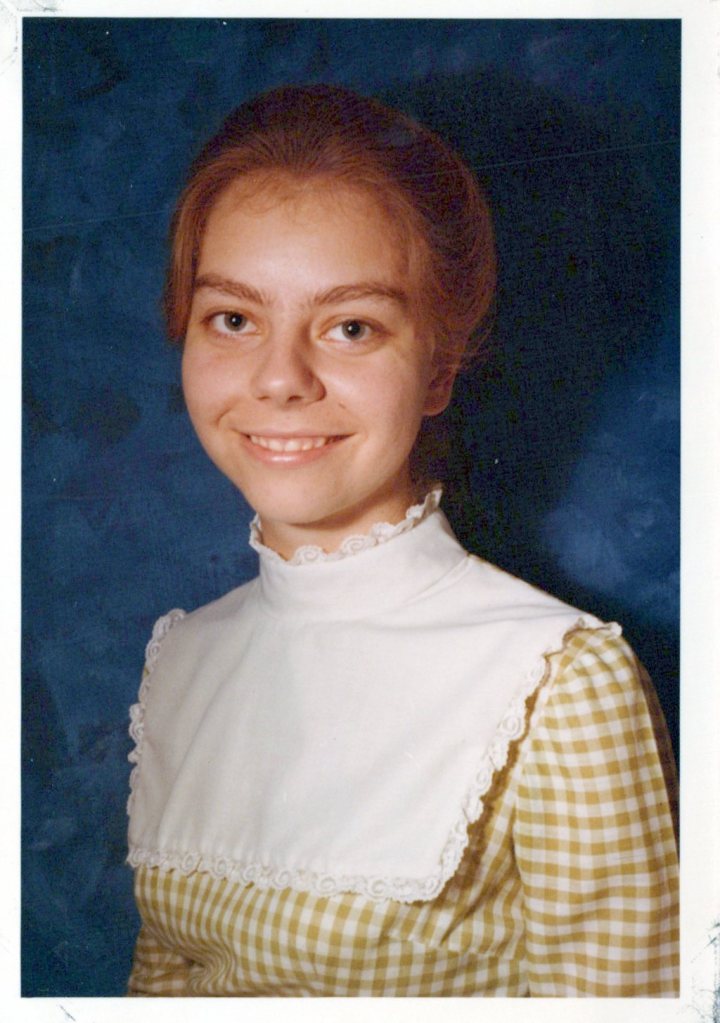
Mabel, 1972


 Confessions from the Sixth Child out of Seven
Leave a reply to Jan Cancel reply