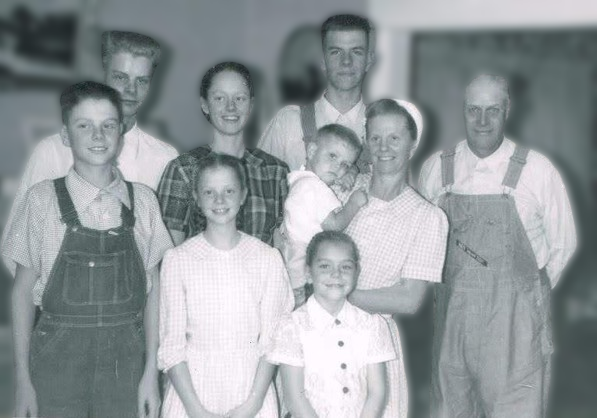
Ma, Helen Irene (Berge) Manning, was born in 1922 to Carl Berge and Mabel (Grotness) Berge. They lived on a small farm near Glen Flora, Wisconsin. Ma was the fourth born out of seven in her family. Her siblings in order: Jim, Emma, Clarence, Helen, Marie, Alice and Margaret.
Ma’s mother (Mabel) died shortly after Margaret was born due to pneumonia. Ma was six years old when her mother passed. Her dad, Carl Berge, had seven children to care for without his wife. He decided he could manage the household with the help of the oldest kids, but couldn’t imagine how he could care for an infant. Mabel’s father (Jens Grotness) took three-month old Margaret on a train to Minnesota to live with Mabel’s sister.
The rest of the family took care of each other. Emma managed the household while her dad was at work in the field or logging. The kids slept in the loft on straw tick mattresses, and during the winter they would wake up with snow or frost on the blankets.
Their family lived in the old Glen Flora Country School house that was no longer being used as a schoolhouse. This building is now restored and relocated to the Rusk County Fairgrounds in Ladysmith Wisconsin as The Little Red School House.
Ma and her sisters would regale us with stories of growing up in the old schoolhouse with their dad. They were very poor, but Carl managed to eek out enough provisions to feed the family. He would go hunting for venison outside of the official state hunting season. This was a time when game wardens would issue a substantial fine, and confiscate the venison meat if it was discovered you were hunting out of season. During winter months, Carl would tell the kids he had to go out for a while. The oldest kids were instructed to place a lit lantern in the window if anyone stopped in for a visit when he was gone. That way he would know there was a guest in the house, and he would hide the deer in the shed in order to avoid letting anyone know he had an illegal deer.
On another occasion, Carl had met a nice lady he thought would be a wonderful wife and stepmother to his children. He told the kids he was bringing this lady for a visit to spend a few weeks with them. He asked them to be kind and welcoming to her. He explained how nice it would be to have her help if she agreed to marry him. The oldest daughters wanted nothing to do with a new mother. Instead of being nice to her, they treated her with disdain and even took her pretty bra and panties off the clothes line and burned them in the wood stove. After the disastrous visit, Carl decided it was too much to ask of his kids to accept a new mother, and he never brought another potential wife home.
Carl apparently would always find a way to be optimistic. Early in the morning, he would get up and fire up the wood heater. Then he would begin thinking about what to cook for breakfast for all the kids. He would look around and say cheerily, “If we had some bacon, I would make bacon and eggs – if we had the eggs.”
By the time Ma was in high school, she was the oldest daughter in the house as the older sisters had moved out. She was responsible for the garden harvest in the fall of the year, so was unable to attend school. She worked at home harvesting and preserving all the garden produce, then attended school during the winter months. Ma also went with her dad, Carl, to the logging camp during winter months to work as a cook for all the men who logged the trees in the woods and lived at the camp until spring when the river was high enough to transport the logs down the river to the nearest town.
Ma spent one summer working as a nanny in Chicago. She worked for a wealthy family caring for their child and helping with housework. Ma decided that city life was not for her.
Ma met Pa at a country dance. Pa played fiddle and clarinet in a band. He was tall, dark hair and handsome. Pa was living in Rusk County Wisconsin in a small house along Highway 73 about 10 miles from Glen Flora where Ma lived. They married in May 1942.
Ma was young, strong and resourceful. She raised seven kids with few of the modern appliances and utilities that we now enjoy. Ma moved into the old house with Pa. There was no water pump in the house, so water was carried from the pump house by the barn and brought to the house. Grey water was carried back outside and dumped in the “slop hole.”
This was a one-room house with the bed in the living room, a make-shift closet, a wood stove and electric lights. The outhouse was several yards away across the yard. Six of the children were born while they lived in the old house, first Larry, then Doris, Wayne, John, Jane, and then Mabel. The littlest kids slept in the first floor main room with Pa and Ma while the older kids had sleeping cots in the small attic. The attic was not high enough for them to stand up straight in most places as they grew taller. There was a commode placed in the attic for use during the night so they didn’t have to go to the outhouse. One morning, Doris was multi-tasking by using the commode while putting on her stockings. A mishap occurred and the commode spilled its contents. Doris, being the ever resourceful oldest daughter didn’t call out for help. She looked around to find something to mop up the mess. Ma knew something was amiss when she saw liquid dripping through the seam in the wallboard ceiling.
Ma was kind, loving and generous. She would share whatever she had with anyone who was in need or just happened to stop by. It was not uncommon for friends, relatives or neighbors to stop by unannounced. If it was near lunch or supper time, Ma would graciously invite them to stay for a meal. She always had plenty of potatoes and homemade bread. Sometime that might have been all there was to serve, but she didn’t apologize or make any excuses. She would whip up some “milk gravy” and serve the meal with gladness. Ma was a highly social person and needed interactions with friends to keep her in good spirits.
Sometime in the early late 1960‘s to early 1970’s as the kids were getting older and Larry, Wayne and John were out of the house, Ma acquired a rug loom. By this time the shell of the house was built on top of the basement house. She had the rug loom in the house above the basement. During summer and fall months, she would weave rugs from rags or “rag rugs” as they were called. People would donate their old clothing, sheets, unused fabric and Ma would cut strips of fabric, sew them together and weave a rug. She had a knack for color and cut fabric into strips that would be wound up in big balls. She had to buy the warp and thread up the loom, then she would fill the wooden shuttle with the cloth strips and weave a rug. She sold her rugs by word of mouth as it became known in the neighborhood that she had rugs for sale. Folks would stop by to purchase her beautiful rugs. This provided her own income for the first time since she married Pa. It brought her much joy and satisfaction.
After all of us moved away from home, Ma and Pa eventually moved up into the wood frame house above the basement. Ma now had the whole second floor and a room on the first floor for her rug home based business. She filled the house with boxes and bags of fabric to be used in her rug making. She could never keep up with the manufacturing side, as it was a slow labor-intensive process.
Ma also made beautiful blankets that were stitched together with blocks of donated fabric, filled with a soft batting and tied together with yarn stitches. On occasion, the neighbor ladies would gather to hand stitch a beautiful pieced quilt. They would gather at Ma’s place where she would place it in a quilting frame large enough for several ladies to sit around and hand stitch with their small sharp needles and thin thread. This quilting would take many hours and days, but it provided a social gathering where they would quilt, share lunch and conversation.
Pa died in 1996. Ma continued to live by herself in the country house until about 2005 when she was no longer able to care for herself. She moved in with my sister, Jane. As Ma’s heart was giving out and her care needs increased, It became too much for Jane to manage her teenagers and care for Ma, so Jane brought Ma for a visit to my sister Doris’ place in June 2006. We knew Ma was in her last days on this earth. Ma didn’t want to go to a care center, so Jane and I rallied at Doris’ place and with the help of hospice she was able to live out her final days. When Ma died in 2006, the country house was still overflowing with rug-making fabric.
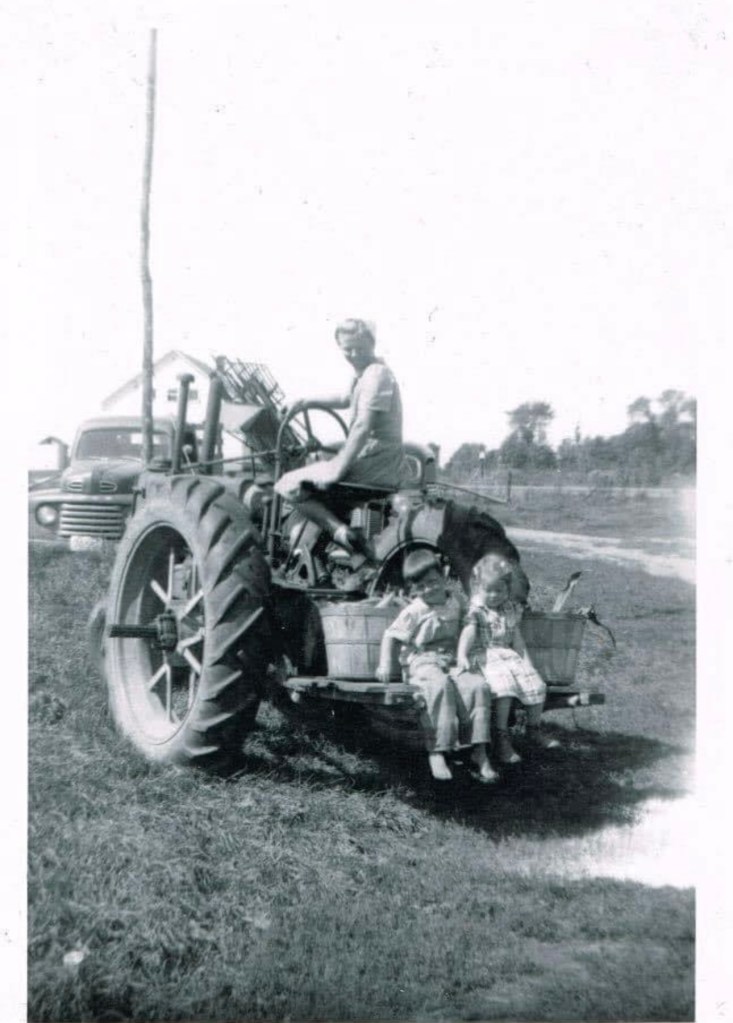
Ma in 1953 hauling garden produce with the John Deere B as John and Jane ride along.
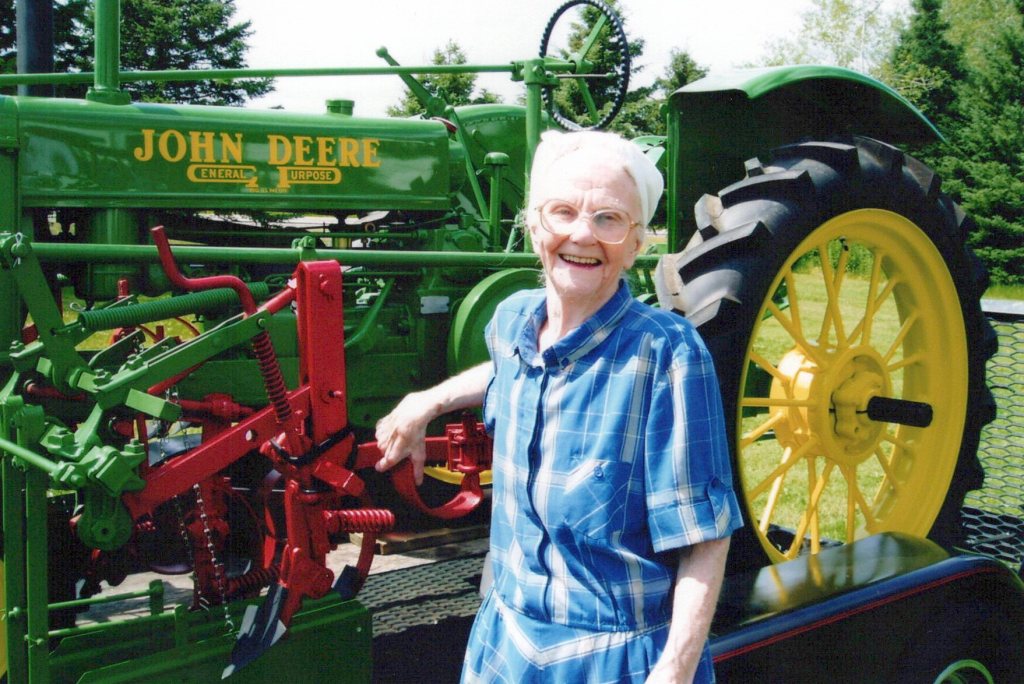
Ma stands proudly in front of the restored John Deere B tractor in 2003.
 Confessions from the Sixth Child out of Seven
Leave a comment